Views: 0 Author: Site Editor Publish Time: 2026-07-27 Origin: Site


Fuel dispensing systems go far beyond basic plumbing infrastructure. They serve as primary cash registers and critical inventory control checkpoints for commercial fleets, bustling retail stations, and heavy industrial sites. Every drop transferred represents direct capital.
Relying on sub-optimal dispensing equipment introduces severe operational risks to your bottom line. Managers often face silent fuel shrinkage, inaccurate inventory reconciliation, hazardous safety leaks, and steep regulatory compliance fines. A failing system drains profitability long before you notice a physical puddle on the ground.
This guide provides a clear, technical teardown of how fuel dispensing operations function. We will detail the specific components you must evaluate closely to ensure maximum durability, exact volumetric accuracy, and strict compliance. You will understand how to protect your liquid assets effectively.
The overall efficiency and accuracy of a dispensing system rely heavily on the precise integration of the **Fuel Pump**, **Flow Meter**, and **Fuel Nozzle**.
Selecting the right equipment requires matching component specifications (e.g., flow rate, positive displacement vs. turbine) to operational volume and fuel type.
Regulatory compliance and ongoing calibration are non-negotiable implementation realities to prevent vapor leaks and measurement drift.
Modern dispensers function as integrated IT assets, requiring secure control systems and accurate pulse outputs for fuel management software.
A highly effective dispensing system does more than simply move liquid. It optimizes the speed of transaction, ensures exact volumetric tracking, and guarantees minimal downtime. These three success criteria dictate the overall health of your fueling operation. When equipment runs efficiently, you process more vehicles per hour. When sensors track volume flawlessly, you eliminate mysterious inventory shrinkage.
Many buyers focus heavily on upfront hardware prices. However, initial equipment expenses remain minor compared to the long-term financial impacts of continuous calibration drift or premature component failure. A meter dispensing just one percent over the legal limit will quietly give away thousands of gallons a year. You must view these systems as long-term financial guardians rather than static metal fixtures.
Operational scenarios drastically alter how you define success. High-volume retail forecourts demand blazing transaction speeds and flawless point-of-sale integration. Conversely, rugged commercial fleet depots prioritize extreme durability and seamless integration into proprietary fleet management software.
Operational Environment | Primary Success Metric | Hardware Priority | Common Bottleneck |
|---|---|---|---|
Retail Forecourt | Transaction speed and customer turnover | Ergonomic interfaces and POS integration | Slow authorization or receipt printing |
Commercial Fleet Depot | High throughput and rugged durability | High-flow components and heavy-duty materials | Filter clogging from bulk fuel |
Industrial / Mining | Extreme reliability in harsh conditions | Corrosion resistance and filtration | Component failure due to environmental debris |
Moving fuel from a storage tank to the dispenser requires immense mechanical effort. The system relies on a Fuel Pump to conquer gravity and pipe friction. The industry uses two distinct pumping methods: suction and submersible.
Suction pumps sit directly inside the dispenser housing. They create a vacuum, allowing atmospheric pressure to push the fuel up from the tank. You should evaluate suction setups for smaller installations where tanks sit close to the dispenser. However, they struggle over long distances and can experience vapor lock.
Submersible turbine pumps (STPs) live directly inside the actual fuel tank. They push the liquid outward under pressure. STPs represent the ideal choice for high-volume, multi-dispenser environments. A single STP can supply multiple fueling lanes simultaneously. They completely eliminate vapor lock issues and maintain high flow rates over long piping runs.
The system needs a mechanism to translate physical fluid movement into verifiable data. The Flow Meter acts as the financial engine of the entire operation. It measures exact volumes before the liquid ever reaches the customer.
Most stations use positive displacement meters. These devices use internal pistons or rotating disks to trap exact amounts of fluid. Every rotation corresponds to a known volume. They offer incredibly high accuracy for standard fuels like gasoline and diesel. You must prioritize meters known for minimal calibration drift. When internal parts wear down, fuel slips past the measuring chamber uncounted.
For more demanding applications, engineers use Coriolis or mass flow meters. These measure fluid mass through vibrating tubes rather than trapping volume. They handle varying densities perfectly. While they cost more, they experience virtually zero mechanical wear.
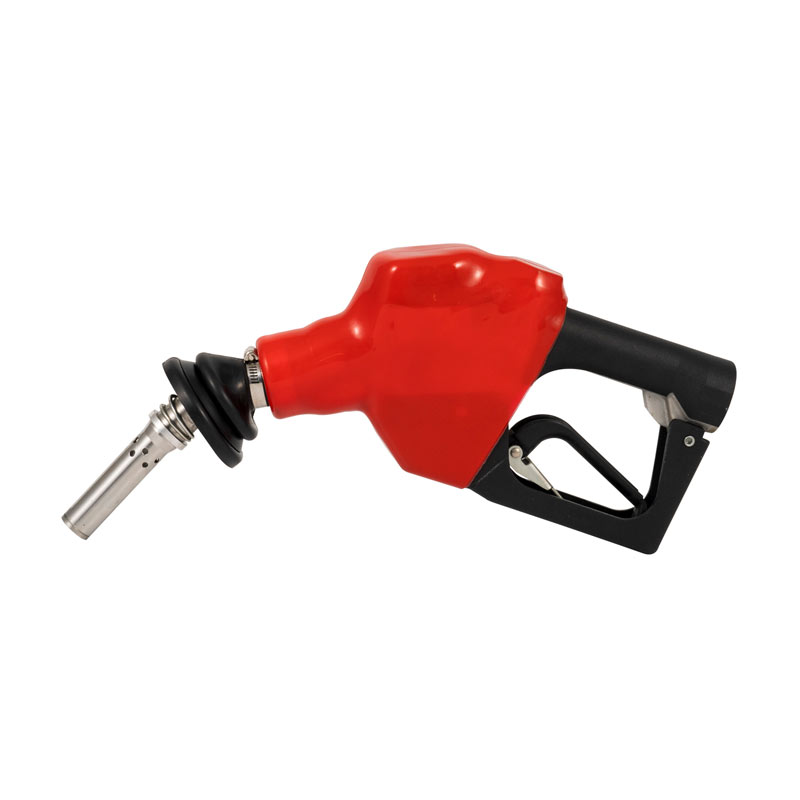
The final physical connection point dictates the user experience. The Fuel Nozzle features highly complex internal mechanics masked by a simple handle. It controls the final delivery and ensures safety.
Modern nozzles feature a clever automatic shut-off mechanism powered by the Venturi effect. A small vacuum tube runs down the spout. While air flows freely into this tube, the valve remains open. Once rising fuel covers the tip, the vacuum drops rapidly. This pressure change trips an internal diaphragm, snapping the primary valve shut instantly.
When evaluating nozzles, you must scrutinize durability and ergonomic factors. You also need to match flow-rate limits to vehicle tank sizes. Pumping 40 gallons per minute into a small passenger car will cause aggressive splash-back. Conversely, using a standard 10-gallon-per-minute nozzle on a heavy-duty truck wastes valuable driver time.
Understanding the actual fueling process requires mapping out both the liquid path and the digital signal path. The modern dispenser orchestrates a complex sequence of events in a matter of seconds.
Authorization: The user swipes a card or a fleet manager authorizes the lane remotely. The site controller verifies credentials and sends a digital "ready" signal to the dispenser.
Pump Activation: The user lifts the nozzle handle. This triggers a switch, commanding the underground submersible pump to turn on and pressurize the underground lines.
Metering: Fuel travels upward into the dispenser, passing through a primary filter. It then enters the flow meter. The fluid forces the internal components to rotate.
Delivery: The measured fuel travels up the hose, through the nozzle, and into the vehicle tank.
Electronic pulsers bridge the gap between mechanical movement and digital tracking. As the meter rotates, a pulser uses magnetic or optical sensors to count the revolutions. It converts these physical turns into digital pulses. For example, one gallon might equal 1,000 digital pulses. The site controller counts these pulses to display the exact volume and price on the screen.
Because pressurized fuel is inherently dangerous, the transfer process relies on intrinsic security mechanisms. Shear valves sit directly under the dispenser at ground level. If a vehicle accidentally strikes the unit, the shear valve breaks cleanly in half. A spring-loaded mechanism snaps shut instantly, preventing underground fuel from geysering into the air. Furthermore, electronic leak detection sensors constantly monitor the internal sump basin, ready to trigger an emergency shut-off if they detect standing liquid.
Choosing the correct hardware requires aligning your equipment specifications with your daily operational realities. Buying an undersized system creates frustrating bottlenecks, while over-specifying wastes capital.
You must align the system's Gallons Per Minute (GPM) or Liters Per Minute (LPM) rating with the specific vehicles using your site. Standard retail pumps flow at roughly 10 GPM. Heavy-duty commercial trucks require master-satellite setups capable of pushing 20 to 40 GPM. Installing a low-flow system at a truck stop causes immense operational bottlenecks. Drivers will simply avoid your facility.
Fuel compatibility dictates your material requirements. Traditional steel and rubber fail rapidly when exposed to modern alternative fuels. High-ethanol blends (like E85) strip protective linings and degrade standard elastomers. Biodiesel acts as a solvent, cleaning out old pipe debris and clogging filters instantly. Diesel Exhaust Fluid (DEF) proves highly corrosive to carbon steel, requiring pure stainless steel or specialized plastic flow paths.
Future-proofing your investment means demanding open protocols. Your dispenser must integrate flawlessly with existing Fuel Management Systems (FMS) and point-of-sale (POS) architectures. Proprietary communication protocols lock you into a single vendor for future upgrades. Always specify equipment utilizing standard IP-based controllers or widely accepted industry wiring standards to ensure future flexibility.
Installing a dispensing system introduces strict legal obligations. Commercial operations must adhere to rigorous Weights and Measures standards. In the United States, inspectors use NIST Handbook 44 guidelines to verify volumetric accuracy. Local metrology laws dictate how much a meter can drift before it incurs heavy fines. You cannot treat compliance as an afterthought; it dictates your right to operate.
Rollouts frequently suffer from predictable installation risks. Improper piping geometry often leads to vapor locks, causing the pumps to stutter and fail. Installers sometimes neglect to install adequate 10-micron filtration immediately before the meter. Without this protection, microscopic pipe scale and debris enter the measuring chamber, permanently scoring the internal pistons and destroying accuracy.
You must establish realistic maintenance assumptions from day one. Flow meters naturally wear down and require periodic recalibration to remain legally compliant. Hoses degrade under intense UV exposure and physical dragging. Nozzles endure heavy impacts daily. You should classify these specific items as regular wear-and-tear components. Schedule their replacements proactively rather than waiting for a catastrophic failure during peak business hours.
Protecting your fuel assets requires a deep understanding of how specific hardware components interact. The pump pressurizes the system, the meter acts as the financial auditor, and the nozzle controls the final physical transfer. When these three elements synchronize seamlessly, your operation runs smoothly and profitably.
Before requesting vendor quotes, audit your current throughput data. Calculate your peak fueling hours, identify your specific fuel types, and review your local compliance requirements. Use this data to build a rigid specification sheet. Refuse any hardware quotes lacking adequate flow rates or proper chemical compatibility.
Take action by consulting a certified petroleum equipment integrator. Request a detailed site assessment. A qualified technician will help you spec the appropriate hardware, ensuring your new dispensing architecture remains accurate, safe, and highly efficient for years to come.
A: Premature shut-offs usually stem from fuel splash-back inside the vehicle's filler neck. If the vehicle's internal venting pipe gets clogged, fuel backs up quickly. This triggers the nozzle's automatic Venturi shut-off diaphragm. Additionally, blocked vapor recovery systems or a damaged nozzle spout can simulate this pressure change, causing the handle to click off constantly.
A: Commercial operations should calibrate their meters at least annually. High-volume locations may require semi-annual calibration. Local metrology laws usually dictate the strict legal timeline. However, if your fuel management software detects sudden inventory variances or shrinkage, you should order an immediate recalibration regardless of the standard schedule.
A: Industry terminology distinguishes the two by location and function. The "pump" physically moves the liquid out of the storage tank. The "dispenser" sits above ground on the fueling island. The dispenser does not pull the fluid; it simply houses the meter, the electronics, the hose, and the nozzle to control and measure the delivery.


